
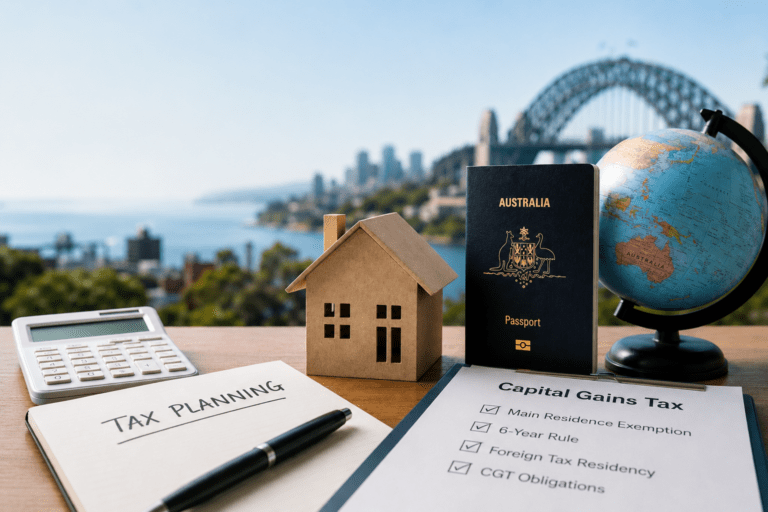
If you own property in Australia and are planning to move overseas, one of the biggest financial questions is often:
“Should I sell before leaving or keep the property while overseas?”
The answer can have major Capital Gains Tax (CGT) consequences.
Many Australian property owners are aware of the “6-year rule” and assume they can simply rent out their former home while overseas and still sell tax-free later. However, the rules surrounding foreign tax residency have changed significantly in recent years.
Depending on whether you are considered an Australian or foreign tax resident at the time of selling, the tax outcome can be dramatically different.
Below is a simplified overview of how these rules generally work, followed by the tax pros and cons of three common scenarios faced by Australians relocating overseas.
What Is the 6-Year Rule?
Under Australian tax law, your family home (often called Principal Place of Residence or PPOR) is generally exempt from Capital Gains Tax when sold.
The so-called “6-year rule” is a provision that allows homeowners to continue treating a property as their main residence for CGT purposes, even after they have moved out and rented it to tenants during the first 6 years after moving out.
In practical terms, this means that someone may move overseas, lease out their Australian home, and still potentially preserve access to the main residence exemption for a period of up to six years while absent.
This rule gave Australians considerable flexibility. A family relocating overseas for work, for example, could retain their Brisbane home as an investment, collect rental income while away, and potentially return later without losing the favourable tax treatment attached to their principal residence.
Importantly, if the owner moves back into the property and genuinely lives there again, the six-year period may potentially restart.
However, this is where many people stop reading — and where the biggest misunderstanding often begins.
The Critical Role of Foreign Tax Residency
This is one of the most misunderstood areas for Australians relocating overseas.
While the 6-year rule still exists, many property owners are surprised to learn that foreign tax residency can significantly affect how the main residence exemption applies when selling Australian property.
In practical terms, this means that even if a property was genuinely your family home for many years — and even if you would ordinarily expect the 6-year rule to protect you — you may still lose access to the main residence Capital Gains Tax exemption if you are considered a foreign tax resident at the time of sale.
It is also important to understand how the Australian Taxation Office determines tax residency. Many people assume that being an Australian citizen, permanent resident, or planning to eventually return automatically means they remain an Australian tax resident. In reality, residency is assessed based on factors such as where you live, work, maintain financial ties, and the strength of your ongoing connection to Australia.
This is why the timing of a sale can become so important, as the tax outcome may be very different depending on whether:
- You sell the property before leaving Australia
- You sell while living overseas
- You sell after returning to Australia and re-establishing Australian tax residency
Below, we explore the pros and cons of each scenario.
Scenario 1: Selling Before You Move Overseas
From a tax perspective, selling before departure is often the cleanest and least complicated option.
If the property qualifies as your Principal Place of Residence, selling while you are still an Australian tax resident will generally preserve access to the main residence exemption, meaning no Capital Gains Tax apply.
For many owners, this option also removes uncertainty around future tax residency, overseas tax obligations, and changing personal circumstances.
The main downside, however, is missing out on future Australian property growth and losing the flexibility of retaining a home in Australia if you family plans change.
Scenario 2: Keeping the Property and Selling While Living Overseas
While this option can provide rental income while overseas and continued exposure to the Australian property market, it is often the least tax-efficient scenario.
If you are classified as a foreign tax resident at the time of sale, access to the main residence exemption may no longer be available, even if the property was previously your family home and you expected the 6-year rule to apply.
Depending on how long the property has been held, the amount of capital growth, and how long ago you stopped being an Australian tax resident, this can potentially result in a significant Capital Gains Tax liability.
Scenario 3: Keeping the Property While Overseas and Selling After Returning to Australia
A third option is to keep the property while living overseas and only sell after returning to Australia and re-establishing Australian tax residency.
In most circumstances, this may lead to a more favourable tax outcome than selling while classified as a foreign tax resident, while also allowing continued exposure to the long-term property growth.
However, the final outcome may depend on factors such as how long you lived overseas, whether Australian tax residency was genuinely re-established, and how the main residence exemption applies across different ownership periods.
Final Thoughts
For many owners, selling before departure may make the most financial sense.
For some others, retaining the property may still make sense — but mostly with a clear path to regain Australian tax residency before cashing out.
If you are planning to relocate overseas and would like guidance on the best timing to sell your Brisbane property, feel free to contact Sergio Sanchez.